

Subsidizing Manhattan farmers
Here’s an excerpt from Agriculture Secretary Mike Johanns’ remarks to the Tennessee Farm Bureau Federation in Nashville on August 9th.
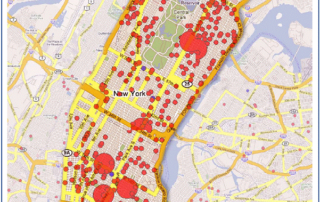
Now you’re looking at that map and you’re saying to yourself, Mike, you’re the Secretary of Agriculture, and you’re supposed to be talking about agriculture and that looks like a map of a city. It is a map of a city. In fact that’s a map of Manhattan in New York City. But I can be even more specific. One of those streets on the right-hand side of that map is Park Avenue. Now if you’ve ever had an opportunity to visit that part of the world, these folks live in very, very expensive housing. Let me put it that way. This is some of the most expensive property anywhere worldwide, certainly in the United States. What are all those dots? People who are receiving farm subsidy payments under the Farm Bill.
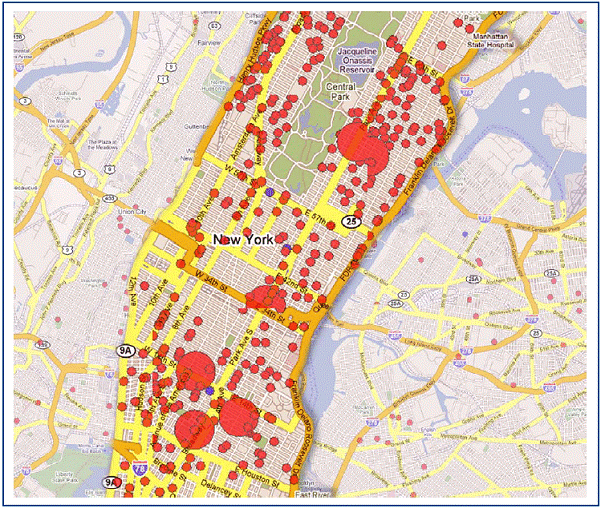
What are those big dots where it looked like somebody’s red ink pen bled? Those are people receiving over a quarter million dollars annually.
Now ladies and gentlemen, there isn’t a person, a farmer in America and I think I know them because I grew up with them and I’ve been around farmers my whole life that believes that’s what should be happening with our farm programs. And I’ll go even further. I believe America supports our farmers, but we have to make the case whether we’re in town or in the country that these programs make sense, that they are a wise federal policy and a good investment for food security and now fuel security.
And I feel strongly we can make that case. But I also feel strongly we’ve got to deal with these kinds of issues or we’ll lose support for what we’re doing. And so that’s why we have worked to try to figure out the best approach to dealing with this payment limit issue.
The House passed a farm bill on July 27th on a 231-191 vote. The vote was largely party line: all but 14 Ds voted aye, and all but 19 Rs voted nay.
As a reminder:
- Current law: Farmers with annual net income of $2.49 M can receive government commodity payments. Farmers with incomes >$2.5 M cannot. Loopholes exist to make even this limit largely ineffective. Just under a million (985,000) farm operators receive payments now.
- House committee bill: Farmers with annual net income of $999 K can receive government commodity payments. Farmers with incomes $1 M cannot, but some married couples can be treated separately, making the effective limit $2 M. This provision will cut off farm payments from roughly 3,200 farm operators. In addition, some (but not many) of the roughly 4,000 farm operators with incomes between $500K and $1 M will also be cut off. So the total number of farmers cut off is between about 3,200 and about 7,200, and most likely closer to the lower number.
- President’s proposal: Farmers with a three-year average annual net income of $199 K can receive government commodity payments. Farmers with incomes >$200 K cannot. Current law loopholes are eliminated or substantially tightened. This will cut off farm payments for about 38,000 farmers.
We should not be giving farm subsidy payments to upper-income residents of Manhattan. This is one of several reasons why we argue that the next Farm Bill needs more reform than the House-passed farm bill. And it’s a reason why we shouldn’t continue current law by extending the Farm bill.
Veto threat on House energy bills
As a follow-up to last night’s note on the energy bills the House is considering today, here is the Statement of Administration Policy (SAP) on these two bills.
The key sentence is:
Because H.R. 2776 and H.R. 3221 fail to deliver American consumers or businesses more energy security, but rather would lead to less domestic oil and gas production, higher energy costs, and higher taxes, the President’s senior advisors would recommend that he veto these bills.
I won’t repeat the point from last night, but will point out two other problems indicated in the SAP.
Since 2001, the Administration has directly invested over $12 billion in clean, safe advanced energy resources and supported billions more in tax incentives. The Administration, however, strongly opposes raising taxes in a way that will lead to higher energy costs to U.S. consumers and businesses. Repealing the manufacturing deduction for only the oil and gas industry is a targeted tax increase that puts U.S. industries at a disadvantage to their foreign competitors. Changes to the foreign tax credit rules related to foreign oil and gas extraction income and foreign oil-related income will also disadvantage U.S.-based companies by reducing their ability to compete for investments in foreign energy-related projects.
and
The Administration strongly opposes provisions in both bills that would expand the application of Davis-Bacon Act prevailing wage requirements.
Much ado about nothing: the House energy bill
In his State of the Union address, the President proposed an energy plan we call Twenty in Ten. The goal is to reduce U.S. gasoline usage by 20% within 10 years (by 2017). There are two main components to 20 in 10 that would reduce gasoline usage:
- fuel economy standards – we would increase the CAFE (Corporate Average Fuel Economy) standards, and modify the way we do CAFE; and
- we would increase and expand the Renewable Fuel Standard, to encourage (mandate) that more alternative fuels be used domestically.
We’ve got other important policy proposals having to do with fuel, including proposals to increase domestic production of oil and natural gas, to increase refinery capacity, and to double the size of the Strategic Petroleum Reserve. But today I want to focus on the two quantitatively important components of 20 in 10.
We can split our thinking about energy policy into two separate buckets: (1) fuel for transportation, and (2) power (electricity). In America, they’re largely separate. Oil powers 97% of our transportation, with the rest coming from renewable fuels like ethanol and biodiesel. Our power comes from coal (50%), natural gas (20%), nuclear (20%), hydroelectric (7%), wind (0.4%), and a few other smaller sources. Because battery technology isn’t yet advanced enough to make it practical to store electricity and use it for transportation, and because oil is expensive enough that we don’t use it for power, you can think of fuel and power as largely separable policy issues.
When you hear elected officials talk about energy security or energy independence, they’re almost always talking about fuel and not power. The short version is that (1) more fuel-efficient vehicles make our economy less vulnerable to a sudden spike in the price of oil/gasoline, and (2) the more ability drivers have to rapidly substitute other fuels for gasoline, the more flexibility we have, and our energy security is increased.
If the President’s 20 in 10 policy were enacted as he proposed it, the expanded Alternative Fuel Standard would reduce our gasoline usage by 15% in 2017. The proposed CAFE reform would save up to 5% more, for a total of 20%. Although you won’t read it much in the popular press, our proposal is more aggressive than any other major proposal out there.
The Senate passed an energy bill in June that contains these two components, but in different forms. While we have big problems with some of the ways these two policies are implemented in the Senate-passed bill, at least the bill tries to move in the right direction.
Later this week the House will take up two energy bills with much ado. To quote Speaker Pelosi’s website:
Energy independence is a national security issue, an economic issue, and an environmental issue. With gasoline prices at record levels, Americans are feeling the pain at the pump. They worry about the security of our nation and our growing dependence on foreign oil. Fortunately, the answer to this long-term challenge is right here at home.
The New Direction Congress has undertaken an ambitious legislative agenda to lead us on a path to energy independence, strengthen national security, grow our economy and create new jobs, lower energy prices, and begin to address global warming. During the week of July 30th, the House will consider the New Direction for Energy Independence, National Security, and Consumer Protection Act, H.R. 3220. This legislation invests in new energy technologies and innovation to create new jobs; improves energy efficiency for a wide range of products, lighting and buildings to reduce energy costs to consumers; makes the federal government a leader in reducing energy usage and greenhouse gas emissions; and strengthens research and diplomatic efforts on climate change to protect our planet.
You will notice that nowhere in this statement do you see anything about H.R. 3320 reducing gasoline usage. Unfortunately, differences among the House majority have meant that their bills do nothing to reduce our gasoline usage. Zippo.
On the following graph, higher is better: more gasoline savings means our economy is less vulnerable to oil and gasoline supply shocks.
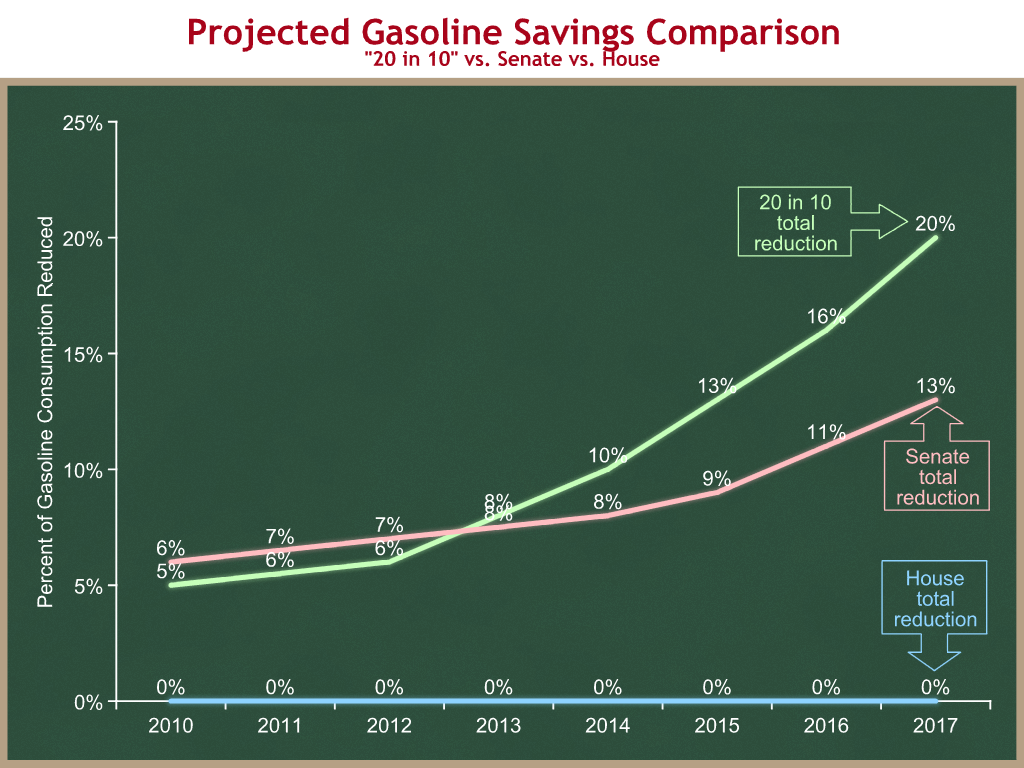
As you can see:
- The President’s proposal would cut U.S. gasoline consumption by 20% within 10 years.
- The Senate-passed bill would cut U.S. gasoline consumption by 13% within 10 years.
- The House bills would do nothing to reduce our gasoline consumption.
So what is in the House bills?
- Repealing some tax credits for oil and gas drilling which were enacted in 2005.
- Raising other taxes on oil companies, in particular denying them foreign tax credits for the investments they make overseas.
- Some provisions to slow down domestic drilling for oil and natural gas.
- Some new appliance efficiency standards, lighting standards, and green building codes.
- Some minor incentives for alternative fuel vehicles, and some research dollars for biofuels (some of which is earmarked).
- Some small business incentives to purchase energy efficient buildings, fixtures, equipment, and technology.
We think almost all of the House bills’ provisions are unnecessary, duplicative, or a hindrance to existing authority, or they move energy policy in the wrong direction. We understand that others might disagree.
Two facts are, however, indisputable:
- This bill does nothing to reduce U.S. gasoline usage. It lacks the two most important components of a policy that one would need to actually increase America’s energy (fuel) security.
- The first two items listed above in the House bills would reduce incentives both for domestic production, and for foreign production by U.S. firms.
When you’re filling up your tank, remember:
- The President is trying to increase American energy security and has proposed policies to significantly reduce America’s gasoline usage.
- The Senate-passed bill goes partway toward the President’s goal (although it’s got some problems in the way they do it).
- The House bills about to be debated ignore the problem entirely.
Taxpayers subsidizing rich farmers
This week we expect the House will consider legislation to extend agricultural programs, more commonly known as the Farm Bill. We think the Farm Bill needs significantly more reform than the bill that will be brought to the House floor. In some cases, that bill actually moves in the wrong direction.
Here is our Statement of Administration Policy on the bill. I’ll look at one element of that bill: should we subsidize rich farmers, and if so, what do we mean by “rich”?
Q: Should farm operators with annual net income of just under $1 million receive taxpayer-subsidized commodity payments? We think the answer should be no.
There is a provision in current law which says that a farmer gets no (taxpayer-subsidized) commodity farm payments if his annual income is greater than $2.5 million. That is not a misprint – under current law, a farmer with $2.49 million of income can receive federal farm payments. (Throughout this note, when I say “income,” I actually mean net income, also known as Adjusted Gross Income. For farmers, there’s a big difference, because your net income subtracts out your business expenses, which in farming can be quite substantial. So $2.5 M of net income is a lot of money.)
The current rules make it easy for you to restructure the ownership structure of your farm to evade the $2.5 M current law limit. A Commission on the Application of Payment Limitations for Agriculture found that the “limits on marketing loan benefits are not effective, only a small percentage of program crop producers reach the current limits on direct and counter-cyclical payments, and many of the largest farms have either restructured or are likely to do so to lessen the extent to which the limits reduce payments.”
The President’s Farm Bill reform proposal would lower the income limit for all farm commodity payments from $2.5 million annually, to $200,000. (You actually get to average your income over three years, and that amount can’t exceed $200 K.)
The President’s proposal would also tighten several rules in current law, provisions that now allow farmers to work and restructure around the current law limit. Tightening these rules would mean that the $200 K limit would actually be binding.
His proposal would tighten but not lower the overall maximum amount of subsidies a farmer can receive from the government: $360,000 per year. Again, this is not a misprint.
Our best guess is that our proposal would cut off farm payments for roughly 38,000 farm operators with net income greater than $200,000 per year.
The bill that the House will consider this week will be quite similar to the bill reported from the House Agriculture Committee last week, chaired by Rep. Collin Peterson (D-MN).
That bill would lower the income limitation from $2.5 million per year, to $1 million per year. And it eliminates the payment cap on one type of payment, “marketing loan payments,” allowing the largest producers to capture even larger subsidy payments. If the loopholes aren’t too weak, this proposal would cut off farm payments for about 3,200 of the highest-income farm operators (compared to our 38,000).
Now advocates for the Peterson bill point out that their bill also has a lower limit, of $500 K per year. Unfortunately, this limit only applies to farm operators between $500 K and $1 M of income who get more than 2/3 of their income from farming. At most, there are another roughly 4,000 farms in this income range, but most of them don’t meet this 2/3 test.
To summarize:
- Current law: Farmers with annual net income of $2.49 M can receive government commodity payments. Farmers with incomes >$2.5 M cannot. Loopholes exist to make even this limit largely ineffective. Just under a million (985,000) farm operators receive payments now.
- House committee bill: Farmers with annual net income of $999 K can receive government commodity payments. Farmers with incomes $1 M cannot, but some married couples can be treated separately making the effective limit $2 M. This provision will cut off farm payments from roughly 3,200 farm operators. In addition, some (but not many) of the roughly 4,000 farm operators with incomes between $500 and $1 M will also be cut off. So the total number of farmers cut off is between about 3,200 and about 7,200, and most likely closer to the lower number.
- President’s proposal: Farmers with annual net income of $199 K can receive government commodity payments. Farmers with incomes >$200 K cannot. Current law loopholes are eliminated or substantially tightened. This will cut off farm payments for about 38,000 farmers.
This is one of several reasons why we argue that the next Farm Bill needs “more reform” than that soon to be considered in the House.
Veto threat: Fairness Doctrine
The Federal Communications Commission (FCC) instituted the Fairness Doctrine regulation in 1949, requiring that broadcasters design programs “so that the public has a reasonable opportunity to hear different opposing positions on the public issues of interest.”
The FCC abolished the Doctrine in 1987 after concluding that “a multiplicity of voices in the marketplace assured diversity of opinion.” Since then, a variety of alternative broadcast voices have flourished. In addition to newspapers and television, the public square open for debates has expanded to include talk radio, cable and satellite television, and the internet. The marketplace has allowed free speech to flourish.
Some Democrats in Congress have indicated their desire to seek legislation reinstating the Fairness Doctrine, in particular to regulate the content of radio broadcasts. In May, The American Spectator reported that Speaker Pelosi and Majority Leader Hoyer will “aggressively pursue” reinstatement of the Fairness Doctrine over the next six months, and in past weeks, Senators Durbin, Kerry, and Feinstein have all supported its reinstatement.
We think it makes sense to look at the diversity of views across different types of media, and not just within one medium. This is particularly true as Americans expand, diversify, and customize their news sources.” Decades ago, most Americans got their news and opinion from the evening news on the major television networks, from their local newspaper, and for some, from one of a few national newspapers.” Now, in addition to those more traditional sources, Americans are also watching dedicated cable news and specialty channels.” They are listening to talk radio over not just AM and FM spectrum, but satellite and internet radio. And they are getting their news, opinion, and commentary on public issues of interest from websites sponsored by news organizations, as well as blogs, discussion groups, and news feeds from individuals and organizations.
The availability and accessibility of diverse points of view on public issues of interest has never been greater, and there is therefore no good reason to reinstate the Fairness Doctrine.
Al Hubbard sent the following letter today to interested parties.
July 13, 2007
Dear _______:
As you probably know, some Members of Congress have recently indicated their desire to seek legislation to regulate what is said on the radio by reinstating the so-called Fairness Doctrine, which was abolished in 1987 after the FCC concluded that “a multiplicity of voices in the marketplace assured diversity of opinion” on our airwaves. Since then, the multiplicity of voices has significantly increased – and the case for the Fairness Doctrine is weaker than ever. Reinstating the Fairness Doctrine would muzzle political debate and free speech. I therefore want you to know that the President would veto any legislation reinstating the Fairness Doctrine.
Sincerely,
<signed>
Allan B. Hubbard
Assistant to the President for Economic Policy and
Director, National Economic Council
The Mid-Session Review
The President spoke about the budget yesterday when we released the Mid-Session Review, the summer update of the budget numbers.
Here’s the least you need to know:
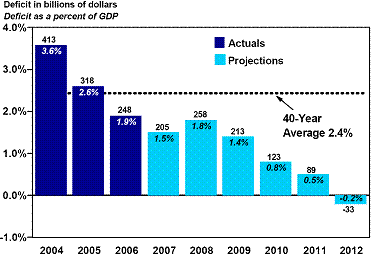
- This year’s deficit (for Fiscal Year 2007) is now projected to be $205 billion.
- Good news: That’s $43 billion lower than last year’s deficit, and $39 billion lower than we projected for FY 07 in February’s budget.
- At 1.5% of GDP, this year’s budget deficit is well below the 40-year average of 2.4% of GDP.
- A strong economy means that federal tax receipts are up. They’re now at 18.8% of GDP, higher than their 40-year historic average.
You can find the Mid-Session Review here, and Budget Director Rob Portman’s press conference here.
Here are a couple good Presidential quotes.
The mid-session review is important. It lets the American people know how we’re doing in meeting what we call fiscal goals. And this year the message is unmistakable. America’s economy keeps growing, government revenues keep going up, the budget deficit keeps going down — and we’ve done it all without raising your taxes.
- America’s economy is growing. Real GDP is projected to grow 2.3% this year. The U.S. economy has expanded by more than $1.9 trillion since the end of the recession in Q4 2001.
- Government revenues keep going up. +8% for the first eight months of this year, relative to last year. We expect the full fiscal year to be 6.9% higher than last year (+$167 B).
- The budget deficit keeps going down. Projected deficit for this year is $205 B, down from $244 B in the February budget. And that’s $43 B lower than last year’s deficit. It’s also declining as a share of the economy.
- Without raising your taxes. The President has proposed and signed four major tax cuts. Still, economic growth has led to higher federal revenues.
More importantly, the size of the deficit is down to only 1.5 percent of America’s economy. One way to be able to measure how we’re doing with the deficit relative to other years is to measure it as a percentage of GDP. We’re estimated to be at 1.5 percent of GDP. That’s well below the average of the last 40 years. We’ve achieved all this deficit reduction without once raising the taxes on the American people.
Third party liability
We gave our policy views recently to the Solicitor General (who represents the Administration in front of the Supreme Court) on a case called Stoneridge Investment Partners v. Scientific-Atlanta. The core policy issue at stake is one of third party liability, and it’s an important element of an ongoing debate about litigation and whether the United States will continue to be the best place in the world to do business. Let’s look at an example.
Tom runs a business.
Richard is a banker. He makes a loan to Tom’s firm, which Tom uses to finance a business transaction.
Tom fraudulently misstates his accounting for this transaction, deceiving his shareholders. Richard knew nothing about Tom’s fraudulent behavior.
Tom gets caught. The Securities and Exchange Commission (SEC) goes after Tom.
Harry is a shareholder in Tom’s firm. After Tom is caught, Harry sues Tom’s firm. (Harry probably has help from some class action lawyers who are happy to help him sue, for a cut.)
Should Harry also be allowed to sue Richard’s bank? Should a third party (whether a banker, supplier, or other service provider) that does business with a firm be subject to lawsuits from that firm’s shareholders, if that firm behaves fraudulently? We think the right answer is no. Imposing liability would impose significant costs that we believe would harm the U.S. economy, and make doing business in the U.S. less attractive.
In the scenario above, if Richard’s bank were sued, a negotiation between the bank and Harry (or, more likely, between the bank and the class action lawyers who represent Harry) would probably ensue. The increased costs imposed on Richard’s bank would not only make the bank less profitable, but they would also raise financing costs for other firms. Higher financing costs reduce investment, deter innovation, and slow economic growth.
In addition, a third party will obviously know less about a firm’s books and operations than the firm’s executives and board of directors. Bankers, suppliers, and service providers are focused on running their own business, and not on supervising the business of their clients. Federal securities laws rightly impose the responsibility for corporate oversight of a company’s accounting and operations on that company’s executives and board, not third parties. It’s wasteful and inefficient to have multiple parties responsible for the same due diligence on one firm.
Finally, such a requirement would be unfair to firms that are good actors. The threat of litigation would force many good actors to pay to settle lawsuits for bad behavior on the part of another firm, something over which the good actor has no control. Spreading the costs of that litigation risk away from the bad actors also reduces the deterrent that exists today to discourage bad actors from behaving badly.
We think that current enforcement tools are strong enough both to deter bad behavior by Tom, and to compensate Harry for his losses. The SEC has criminal enforcement authority that it can and does use against Tom, and also against Richard and his bank if he facilitates Tom’s fraud. Harry can sue Tom. In addition, if Richard the banker also violates SEC laws, the “Fair Funds authority” created under the Sarbanes-Oxley Act gives the SEC the power to collect from Richard to repay Harry and the other defrauded shareholders.
So what’s the process? The SEC decided on a 3-2 vote to ask the Solicitor General (SG) to support the plaintiffs in Stoneridge. The Solicitor General requested the President’s policy view, and the President expressed a policy view (similar to that expressed above) that differs from the SEC’s. The President did not direct the Solicitor General as to which side the SG should take in the Stoneridge case. The SG also received views similar to the President’s from the Treasury Department, as well as from the (independent) Federal Reserve and the Office of the Comptroller of the Currency (an independent banking regulator).The SG decided Monday not to file a brief in support of the plaintiffs. He now has about four more weeks to decide whether to file a brief in support of the defendants.
The United States has the strongest economy and the most competitive financial markets in the world. But increased litigation risk is a serious problem now, and any increase in the costs of litigation risk can further damage our strong economic and financial system. We want a system in which good behavior is encouraged, bad behavior is deterred, most people are focused on producing the goods and services that make our economy grow, and the wasted costs of litigation are as small as possible.
Update: here’s the opinion, which went 4-3 our way. We’re pleased.
The G-8 agreement (especially on climate change)
Here is the 38-page “Summit Declaration” from the G8 summit, released earlier today. The summit and the document cover many important economic topics. I’m going to focus on the climate change section, which is receiving a lot of press coverage.
We are very pleased. Let me start with some quotes from the President while he was in Germany this week:
(Y)ou’re not going to have greenhouse gas emissions that mean anything unless all nations, all emitters are at the table. And if China is not a part of the process, we all can make major strides and yet there won’t be a reduction, until China and India are participants. And what I have said is, here’s a way to get China and India at the table.
One, it’s going to be very important for us to continue to discuss climate change in a way that actually accomplishes an objective, which is the reduction of greenhouse gases over time, and the advancement of technologies, which will yield to better environmental policy, as well as energy security.
The United States can serve as a bridge between some nations who believe that now is the time to come up with a set goal, as well as a — I said, the remedy, and those who are reluctant to participate in the dialogue. So I laid out an agenda that can move the process forward within the framework of the United Nations, that, in essence, says that we’ll be setting a goal at the end of 2008 — that “we” being the major emitters — within the framework of the U.N. In other words, this will fold into the U.N. framework. And that enables us to get China and India at the table to discuss how we can all move forward together.
Secondly, in my speech I said we’ll come up with our own policies to meet an interim goal for our country, as well as a national goal — or international goal for the rest of the world.
And here is Dave McCormick, who is Steve Hadley’s economic deputy on the National Security Council staff and the President’s “G8 sherpa”:
I think you’ll see an enormous amount of agreement and consensus around a number of key principles. Again, the importance of climate being thought of within the context of energy security and development; the focus on technology — an enormous focus on technology and the technology being a key driver of dealing with these common challenges and opportunities together. There was an absolute consensus, building on the President’s speech last week, on the crucial importance of bringing the major emitting economies into a discussion, an agreement on the path ahead. And so that was a highlighted part of the agreement and text, with a specific outline of how that process with major emitters would move forward, and the role that the G8 would play and the United States would play, from a leadership standpoint, in pushing that dialogue forward to an appropriate and successful end.
Despite what an initial AP article says, the G8 leaders did not agree to halve greenhouse gas emissions by 2050. That is one specific proposal that will be “seriously considered” during the upcoming “major emitters process” that the U.S. will host. In fact, the EU, Japan, and Canada each have different versions that we expect will be “seriously considered” during that process. In addition, it has not been widely reported that the EU, Japanese, and Canadian proposals recommend that the long-term goal be a “common vision” (or aspirational) goal, and not a binding one.
Consistent with the President’s proposal last week, the G8 leaders agreed to set a long-term global goal based on emissions (not temperature) in the upcoming process. They did not, however, agree in Heiligendamm to any specific quantitative emissions goal. They also did not agree to create a global cap-and-trade system or a global carbon market. And because this process will only work with participation by China, India, and other major emitters, the outcome should differ from the Kyoto deal (which the U.S. and others rejected). The most constructive way to make progress with China and India is to give them an equal seat at the table and to make sure the discussion includes energy security and economic development priorities. The new “major emitters process” does that.
Let’s look at what they did agree to, and compare it to what the President proposed a week ago today. Each of these elements that I highlighted last week is now included in the G8 declaration:
- He’s proposing a new process.

- The discussion would involve the “major emitters” – nations that are responsible for the majority of the world’s greenhouse gases, including India and China.
- The top major emitters are: U.S., China, the European Union, Russia, Canada, Japan, India, South Korea, Australia, Brazil, Mexico, and South Africa. So everyone in the G8 is included, as well as several others.
- This year, China’s greenhouse gas emissions are expected to exceed U.S. emissions, and by 2020, China may use 3X-4X more coal than the U.S. And 75% of the future growth in emissions will come from the major emerging economies.
- We (the U.S.) “will convene a series of meetings.”
- The group would work to “set a long-term global goal for reducing greenhouse gases.”
- Such a goal would be an aspirational (non-binding) global goal.
- The Kyoto Protocol (which the U.S. rejected) expires in 2012. This new process is to establish a framework that would take effect after that. By the way, it can take place within the 1992 U.N. Framework Convention on Climate Change.
- Each country should set its own targets, and its own methods for hitting those targets.
- The group should have all this worked out by the end of 2008.
Some additional and important practical features of the President’s proposal are well-reflected in the G8 text:
- the value of a “bottom-up approach” in which we tackle issues on a sector-by-sector basis along the lines of the successful Asia-Pacific Partnership on Clean Development & Climate that the U.S. initiated with Australia, China, India, Japan, and Korea; and
- coal, nuclear, calling on other countries to invest more in R&D (like we already are), and opening up trade by eliminating tariff and non-tariff barriers.
This is a major achievement in finding convergence among a group of countries that have had difficulty finding consensus in the past on this issue. Kudos go to Dave McCormick, and to the Chairman of the President’s Council on Environmental Quality, Jim Connaughton.
The President’s trip to Europe
The President left this morning for a nine-day trip to Europe.
Q: Where is he going?
A: (1) Prague, Czech Republic. (2) Heiligendamm, Germany, for the G-8 meetings. (3) Jurata and Gdansk, Poland. (4) Rome and the Vatican. (5) Tirana, Albania. (6) Sofia, Bulgaria.
The G-8 meetings are Wednesday, Thursday, and Friday. There will actually be three groups of leaders meeting:
- G-8 leaders: Canada, France, Germany, Italy, Japan, Russia, U.K., USA
- G-8 + 5, where the + 5 are large developing economies: Brazil, China, India, Mexico, and South Africa
- G-8 + some key African leaders: Algeria, Egypt, Nigeria, Senegal, and South Africa.
Quiz: Name all the leaders in each group. (Answer is at the bottom.)
The themes of the G-8 meeting are Growth and Responsibility. As part of the lead-up to this meeting, the President rolled out four major initiatives last week:
- tightening economic sanctions against the Sudan and imposing additional sanctions, to address the ongoing genocide in Darfur;
- a proposed doubling of the American $15 B spending commitment for PEPFAR, the President’s Emergency Plan For AIDS Relief; (We’re actually up to $18 B in spending for ’08.)
- a new climate change framework; and
- a new Africa Financial Sector Initiative and a new Africa Educational Initiative.
In addition the President re-emphasized some long-standing principles in a major international development speech to the U.S. Global Leadership Council last Thursday. Here they are, in the President’s words.
On trade:
Trade is the best way to help poor countries develop their economies and improve the lives of their people. When I took office, America had free trade agreements with three countries. Today we have free trade agreements in force with 14 countries, most of which are in the developing world. Three weeks ago, my administration and Congress agreed on a new trade policy that will be applied to free trade agreements with Peru, Colombia, Panama and South Korea.
(T)he United States also seeks to open markets to the Doha round of trade negotiations. Doha represents a once-in-a-generation opportunity to help millions in the developing world rise from poverty and despair. If you’re interested in helping the poor people, you ought to be for trade and opening up markets for their goods and services. And the Doha round gives us an opportunity to do just that.
We put forward bold proposals to help conclude a successful Doha round. And at the G8 summit next week, I’m going to urge other nations to do the same. A successful Doha round will benefit all our countries and it’s going to transform the world.
Here’s some quantification of the President’s point about trade being the best way to help poor countries and their citizens:
- Full liberalization of global merchandise trade would be worth about $140 billion per year to developing countries, nearly double last year’s combined G7 development assistance of $75 billion.
- World Bank studies say that in the 1990s, per capita real income grew 3X faster for developing countries that lowered trade barriers than for those that did not. Also, economic growth is on average 1.2 to 2.6 percentage points higher after a country dismantles its trade and investment barriers and opens its economy.
- Another World Bank study estimates that a successful Doha round could lift tens of millions of people out of poverty.
- About 70% of the duties on goods that developing countries pay go to other developing countries. (So poor countries are restricting trade with each other, and hurting both sides.)
On debt relief:
Building progress and prosperity to struggling nations requires lifting the burden of debt from the poorest countries. That makes sense. It doesn’t take a Ph.D. in economics to figure out, if you’re paying a lot of money on interest, you’re not having enough money to support your own people. In the past, many poor nations borrowed money, and they couldn’t repay the debt. And their interest payments were huge. And, therefore, they didn’t have the opportunity to invest in education and health care. So the administration, my administration worked with G8 nations to ease the debt burden. We’re not the first administration to figure this out. My predecessor did the same thing, because it’s the right policy for the United States of America.
Two years ago at Gleneagles, the G8 nations agreed to support a multilateral debt relief agreement that freed poor countries of up to $60 billion in debt. This year, we built on that progress, when the Inter-American Development Bank approved another debt relief initiative for some of the poorest nations in our neighborhood, in our own hemisphere. This initiative will cancel $3.4 billion owed by five countries: Bolivia, Guyana, Haiti, Honduras, and Nicaragua. And that represents more than 12 percent of their combined GDP, an average of nearly $110 for every man, woman, and child in these countries. And this money is now free to help these nations invest in improving their lives of citizens. It makes sense to forgive debt. If you’re interested in helping the poor, it makes sense for the developed world to forgive the debt. And that’s what the United States will continue to do.
On the Millennium Challenge Account:
The United States is helping developing nations build these and other free institutions through what we call the Millennium Challenge Account. Under this program, America makes a compact with developing nations. We give aid, and in return they agree to implement democratic reforms, to fight corruption, to invest in their people — particularly in health and education — and to promote economic freedom. Seems like a fair deal, doesn’t it — taxpayers’ money from the United States in return for the habits and procedures necessary for a solid society to develop. We don’t want to give aid to a country where the leaders steal the money. We expect there to be accountability for U.S. money and that’s the principle behind the Millennium Challenge Account. Eleven nations have compacts in place worth nearly $3 billion. And now 14 additional nations are eligible to negotiate compacts with the Millennium Challenge Corporation, headed by Ambassador Danilovich.
Answers to the quiz:
G8: Canada – Harper; France – Sarkozy; Germany – Merkel; Italy – Prodi; Japan – Abe; Russia – Putin; U.K. – Blair; USA – Bush.
+5: Brazil “Lula” da Silva; China – Hu; India – Singh; Mexico – Calderon Hinerosa; South Africa – Mbeki
Africa: Algeria – Bouteflika; Mubarak – Egypt; Nigeria – Yar-Adua (President-elect); Senegal – Wade; South Africa – Mbeki
What did President Bush announce today on climate change?
The President spoke today to the U.S. Global Leadership Council about America’s international development agenda. You can find his remarks here. His wide-ranging speech covered trade, debt relief, education, AIDS, and malaria. There was a lot to highlight, but I’m going to focus first on his new climate change proposal. Here’s the key quote:
In recent years, science has deepened our understanding of climate change and opened new possibilities for confronting it. The United States takes this issue seriously. The new initiative I am outlining today will contribute to the important dialogue that will take place in Germany next week. The United States will work with other nations to establish a new framework on greenhouse gas emissions for when the Kyoto Protocol expires in 2012. So my proposal is this: By the end of next year, America and other nations will set a long-term global goal for reducing greenhouse gases. To help develop this goal, the United States will convene a series of meetings of nations that produce most greenhouse gas emissions, including nations with rapidly growing economies like India and China. In addition to this long-term global goal, each country would establish midterm national targets, and programs that reflect their own mix of energy sources and future energy needs. Over the course of the next 18 months, our nations would bring together industry leaders from different sectors of our economies, such as power generation and alternative fuels and transportation. These leaders will form working groups that will cooperate on ways to share clean energy technology and best practices.
Let’s break it down:
- He’s proposing a new process. This is in part for consideration at next week’s G-8 meeting in Heiligendamm, Germany. (The G-8 members are Canada, France, Germany, Italy, Japan, Russia, the U.K., and the U.S.) Stay tuned for more on the G-8 meeting.
- The discussion would involve the “major emitters” – nations that are responsible for the majority of the world’s greenhouse gases. The top major emitters are: U.S., China, the European Union, Russia, Canada, Japan, India, South Korea, Australia, Brazil, Mexico, and South Africa. So everyone in the G-8 is included, as well as several others.
- We (the U.S.) “will convene a series of meetings.”
- The group would work to “set a long-term global goal for reducing greenhouse gases.” Such a goal would be an aspirational (non-binding) global goal.
- The Kyoto Protocol (which the U.S. rejected) expires in 2012. This new process is to establish a framework that would take effect after that. By the way, it can take place within the 1992 U.N. Framework Convention on Climate Change.
- Each country would set its own targets, and its own methods for hitting those targets. Some countries might like a carbon tax, others might like a national cap-and-trade system, others might take a sector-by-sector approach, and still others might set voluntary goals. But each nation decides for itself what makes sense based on its own particular circumstances.
- The group should have all this worked out by the end of 2008. That’s an aggressive, but we think achievable, deadline.
Just in case you’re not a climate change expert, there’s some big news here – especially the U.S. talking about a new process post-2012, and a long-term global goal for reducing greenhouse gases, and expanding the discussion to make sure it includes major emitters like China and India. Here’s the interesting part. Senator Boxer (D-CA) is the Chair of the Senate Environment and Public Works Committee. Senator Inhofe (R-OK) is the ranking Republican member of the same committee. Each is a respected leader in the climate change debate, and let’s just say the debate between them is often quite vigorous. Senator Boxer was quoted today as follows, “I have written to the President twice this year to ask him to convene a summit of the world’s largest emitting nations. Today he has accepted that challenge. I stand ready to assist him with the summit and continuing negotiations in any way I can.” Senator Inhofe said today, “Any international effort that builds off of the Asian Pacific Partnership and includes the developing nations is a positive step forward.” (The Asia-Pacific Partnership on Clean Development and Climate includes six countries that work together to accelerate the development and deployment of clean energy technologies.) Will the papers tomorrow highlight these preliminary indications of bipartisan support for the President’s proposal? Or will they instead focus on areas of disagreement?