
Today the Administration released more detail for the President’s budget. The President tried to emphasize his fiscal responsibility by highlighting some of the programs he proposes to terminate or reduce. Budget Director Orszag released the Terminations, Reductions, and Savings volume.
This morning the President said,
But one of the pillars of this foundation is fiscal responsibility. We can no longer afford to spend as if deficits don’t matter and waste is not our problem. We can no longer afford to leave the hard choices for the next budget, the next administration — or the next generation.
That’s why I’ve charged the Office of Management and Budget, led by Peter Orszag and Rob Nabors who are standing behind me today, with going through the budget — program by program, item by item, line by line — looking for areas where we can save taxpayer dollars.
Today, the budget office is releasing the first report in this process: a list of more than 100 programs slated to be reduced or eliminated altogether. And the process is ongoing.
Here is a comparison of the budgetary savings from President Obama’s proposed discretionary program terminations and reductions, compared to those proposed by President Bush in his last budget:
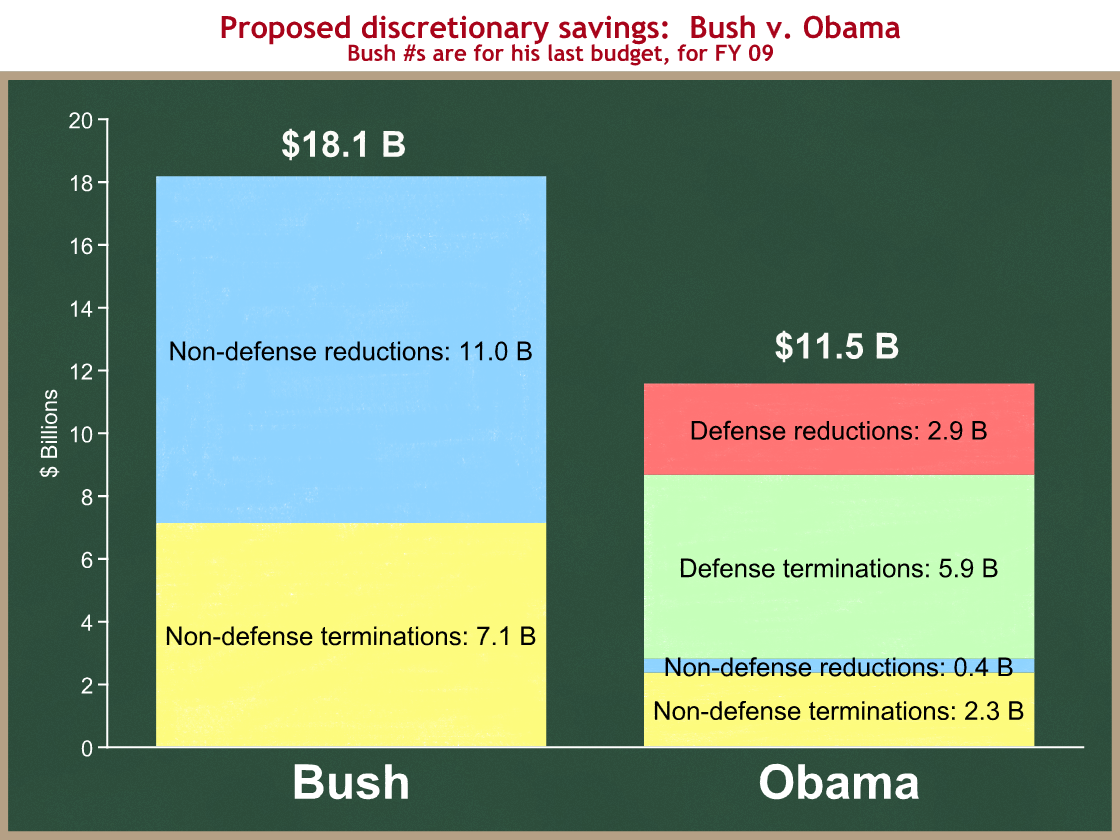
Some observations:
- President Bush proposed $6.6 B (57%) more in discretionary program terminations and reductions than President Obama.
- Three-fourths of President Obama’s T&R savings come from defense.
- President Bush proposed 6.7 times more non-defense T&R savings than President Obama. (= 18.1 / 2.7)
Now this graph covers only the proposed savings from annually appropriated (“discretionary”) programs. The bulk of federal spending is in the mandatory programs. I will cover that separately.
Today the President said, “But these savings, large and small, add up.” It’s too bad they don’t add up to more.


I have come to conclude that Obama, with the full consent of this Democrat Congress, is deliberately deconstructing the nation and ensuring that there is no way to salvage it short of another civil war and/or revolution. That being said, they must have confidence they can stamp out any such thing and retain hegemony.
CornfedPi, love the screen name. Like you I’m mad at both, but especially the Republicans because they betrayed us on fiscal issues. I’m calling myself a Libertarian now. How the heck do we get our country back from this mafia?
I suspect people are missing the point when they emphasize the cuts in Defense. Keep in mind that Job No. 1 is consolidation of power.
If we have to kiss ass to Iran, or Cuba or Russia or whoever, so be it. The most important thing is to keep the reporters in line, and to demonize any potential domestic opposition before it has a chance to pick up steam. Thus attacks on returning veterans (might join up with neo-nazi militia), peaceful Tea Party demonstrators, Rush Limbaugh and other talk radio, econ-entertainer Jim Cramer when he criticized Obama, the Chrysler bondholders….
Presumably the enemies of this country will “smile and wave” for now. The US won’t be hit till we’ve gone too far down the path.
If you’re so smart, why aren’t you getting a bail out?
Not really. Just wanted to say that to somebody.
What that graph needs is a bar showing the deficits next to these “reductions,” and another for the change in unemployment all these terminations will create. He seems to think that there are jobs out there begging for all the people he’s going to terminate from government. Are there?
Every time Obama speaks I wonder anew why anybody thinks he’s so brilliant. Every one of his platitudes could have been uttered by George W. Bush with more credibility.
I’m sorely disappointed by Summers and Geithner, not for their inability to fix things, which hasn’t been demonstrated yet, but for their failure to resign over the size of these deficits.
What I find interesting is the arguments about the Clinton Admin’s ability to hold down the spending and the debt. Here is why I find it interesting. Democrats take notice!
http://tcsdaily.com/article.aspx?id=010209A
Clinton wasn’t a fiscal liberal like Obama. He was better ‘W,’ too. But notice it really got bad in the last 2 years when the Democrats gained control of Congress.
Well, the top 5% got between 30 and 50% of the tax benefit from Bush’s tax cuts. So for every dollar given to a person in the top 5%, 19 lower to upper middle class workers carved up a dollar or two. If you believe that deficits are paid back in the long run with higher taxes, a tax break disproportionately favoring the rich is a tax break that benefits only the rich.
The financial industry provides 30% of the country’s GDP, and around 40% of the profits. It certainly is not a labor intensive sector employing hourly workers with wages impacted by minimum wage, dragging down average incomes. Generating so much money, with such a concentrated group of employees, that sector certainly enjoyed a disproportionately large share of GWB’s tax cuts.
The reason the top pay so much more in taxes, is because they rake in so much more money. The real question is why. A CEO here makes 20 times what a CEO in other first world countries make, and yet our trade deficit is huge. If our GM’s CEO was really worth 20 times what Toyota’s CEO is worth, why are we all driving Toyotas and tuning in to tales of their bankruptcy and bailout? If fund managers, IBs and financial experts really deserve million dollar bonuses, then why can’t they outperform indexes? Why did they precipitate a global financial crisis with speculation reminiscent of past centuries? If they are so efficient at allocating idle capital to growing businesses in need of capital, then why did they all get caught with their money sitting in speculative assets?
The answer is that if given the choice, why not simply keep more money, whether it is deserved or not… simply relying on the kindness of businessmen or capitalist forces to distribute wealth results in great disparity.
The real income of the top percentile has been increasing by around 10% a year, while the real income of the lower half has increased by less than 1% a year. This rising disparity is way outside of historical norms (unless you consider the 1920s). http://img.skitch.com/20090429-c5dyfkt5xw7iytpi2bc1freskm.render.png Why should the top 1% be earning the same % of GDP they were back at the end of the 1920s, the last time rampant speculation accounted for so much wealth?
When did this happen? “We can no longer afford to spend as if deficits don’t matter … We can no longer afford to leave the hard choices … or the next generation.” Maybe if he had said, “Now that all the Democrats and only three Republicans have committed to spending more money in the next several years than has been spent since the founding of the Republic, “We can no longer afford…”
Nothing, I say again, NOTHING!! this man says can be trusted nor believed for any longer than the time the sounds coming from his mouth catch up to the sounds coming from the speakers in the back of the room. NOTHING!!! And watch for this tactic; this white house continually invents false crises, makes outrageous statements, releases phony reports etc. to control the national conversation. This man is extremely, extremely self-referential; he makes everything about himself. Look again at his ‘words’ above. “We can no longer, (therefore) I…”
>Well, the top 5% got between 30 and 50% of the tax benefit from Bush’s tax cuts. So for every dollar given to a person in the top 5%, 19 lower to upper middle class workers carved up a dollar or two. If you believe that deficits are paid back in the long run with higher taxes, a tax break disproportionately favoring the rich is a tax break that benefits only the rich.
Whats missing from you argument, besides the actual sources, is that the top 10% pays 70% of the taxes. In a tax cut, you are necessarily giving back the taxpayer his own money, the bottom 40% pays no tax. the bottom 50% pays 1-3%. So you are implying that somehow the 19 lower to upper middle class workers were shortchanged because, they didnt get a larger percentage of the overall tax cut, when they pay almost none of the tax burden? What is your source for the 30% and 40%? For it to be that High it would most certainly have to include real eastate sale and finance, as well as rank and file bank employees.
This is kind of a tired argument and gets at the heart of one of the tings I believe is behind Obama’s massive debt, and redistribution program. Well besides concentration of power. Your argument seems to be that those who are making so much are somehow ripping off the little guy, that someone who is in the top 1% or 5% or 10% has gotten his money from ill gains You do not state it overtly but you imply it in your argument. A more redistributive model would seem to be better for you from your post. People are generally paid according to their value to an business or partnership. It is a fair trade of value for value. Those at the top apply their experience and intelligence and take the risks of capital that either produces a profit or does not. Anyone in this country has the freedom to do what it takes to get to the top 10% of earners in this country. Those who contiunually provide a high amount of value historically tend to be rewarded, those who do not are fired. Most people at the lower end of the earning workforce provide higher ratio of mechanical labor to thinking labor, and take little or no risk in the outcomes of the company. They are not risking their own capital. That has lower value to a company and they are in fact paid less. There is a MUCH larger supply of lower educated and lower skill workers then well educated, experienced and higher skill workers.
I’ve already gone on too far, but it bothers me that this implication that the top 1%, or 5%, or 10%, are not working for their money or somehow the implied “greed” of these people, makes it right for a block of voters to soak them in order to get personal benefit. If you work hard, delay gratification, save, go to school, maximize your opportunities and ultimately risk your capital in a business, you should be able to get the rewards from it. Instead we are rewarding people who push for instant gratification, dont go to school, dont pay their taxes, dont pay their mortgage etc. We are making the responsible pay twice or three times. We are not rewarding success we are rewarding failure. In this world you tend to get more of what you reward. What happens when the people who are making the top 1% or 5% or 10% get tired of working as hard as it takes to make that money, and find something to do more personally satisfying or go elsewhere? Who is going to make up the 70% of the tax burden because we would rather reward failure then success?
“A more redistributive model would seem to be better for you from your post. ”
Not particularly. In fact, it’s only since I’ve become more highly paid, and surrounded by highly paid individuals, that I’ve come to appreciate just how little pay has to do with merit. When I worked in a cheaper industry, I worked just as hard or harder and had the same level of education and background.
” People are generally paid according to their value to an business or partnership. ”
People are generally not paid according to their value to a business or partnership, rather, they are paid as little as is feasibly possible. I’m not saying it’s evil or good but it is reality.
I am not stating that the top earners are not working hard, or even that their work is not more valuable than those of the lower strata. Nor am I saying that businessmen should not be rewarded for risking their capital.
Regardless, money exists only to facilitate distribution of the products of economic activity. Even though a less skilled worker has less valuable skills, does that automatically mean they should never be able to afford a house and family, or medical care? If the % of income going to the top 1% swells rapidly to 25% of the total, and their pay advances are merit based, there should be some evidence of their merit. Did 99% of mothers suddenly damage their genes, or perhaps consciously decide to raise children without concern for education, training and a good work ethic?
More likely, the merit of individuals is unchanged… if anything the efficiency gains of the American worker has been impressive (outpacing his income growth), and average level of education is rising. I would argue that instead of some inexplicable and unseen plague of unworthiness, simply that the rich get richer for reasons completely unrelated to merit.
“[Bush gave t]ax cuts to increase the take home pay of the top 1%”
Yippee! I’m rich again! Since I saw an increase in my annual take-home and a reduction in my federal income tax burden due to the Bush cuts I can’t see any other logical conclusion.
Cynic, if you pull out your 1040′s spanning that period before and after the cuts and do some basic math I’m willing to bet that you will find that you, too, are “rich.”
Percentage of total taxes paid by top earners during Bush increased faster than their share of total income increased… how much more taxation can be exacted before the goose that creates and manages capital (not money) slows down? Efficiency gains of labor(outside the professions) are attributable to application of capital to better tools, very little to greater or smarter effort of labor. Obama needs to be called out now regarding the coming disastrous unemployment/compensation reduction effects on workers that will inevitably flow from his redistribution policies. Worldwide, capital is on slowdown and strike because it doesn’t trust governments, including Obama’s. And politicians should quit personally profiting by exploiting and creating victims of labor with false labor theory of value notions. Labor in relation to capital has always been in surplus… look around the world and observe that in countries not garnering investment capital, workers are often still building their own houses and living hand to mouth.
” Worldwide, capital is on slowdown and strike because it doesn’t trust governments, including Obama’s.”
You believe that people are out there giving up the chance to make money, as a silent political statement? If they wish to strike to make a political statement, where are the headlines? It’d be much cheaper and more effective for them to contract an advertising agency to make their claims while idling a little cash, rather than idling a ton of capital in silence.
People are idling their capital because they don’t know how to turn it into more money. Why would they? 2 years ago, their best idea was sinking it into real estate or bets about real estate, rather than investing in growth… and that was before 5% of the people lost their jobs, and the rest decided they had to cut back because they suddenly got poorer.
It’s not worth expanding business when demand contracts. For the last few years, the investment class has had more money than they knew what to do with, so they threw it into historically overpriced, unproductive asset bets. If that same money had flowed to lower income brackets, the lower income members would have spent it, and created a reason for the rich to invest in economic growth.
It’s not a coincidence that when economies moved from all wealth, all ownership and risk being concentrated in an upper class, into one which provided for an expansive middle class responsible for much of business that both production and demand for products exploded. The more customers, the greater the business oppertunities. If there is either a lack of customers or a lot of investment capital, then commerce stagnates or diminishes. This is a time of high inequality, where those benefitting from that inequality find themselves unable to profitably expand and instead engage in idle speculation.
“a lot of investment capital” should read “a lack of investment capital”
Comparing proposed Bush discretionary spending cuts with Obama’s is a wasted exercise. GWB-43 threw away any Republican claim to responsible fiscal policy. Regrettably it was much the same with GWB-41. Both declined to present their case to the public to rein in spending and instead took the easy way out. GWB-41 reneged on his “read my lips” promise and quickly raised taxes. GWB-43 just signed every spending bill that hit his desk, deficits be damned.
For Democrats to hold Clinton up as a great economic master ignores the fact that he stepped into an economic recovery from the 90-91 recession + the internet/technology boom + Greenspan monetary pump priming. And he left a emerging recession for GWB-43 to boot. To gain his surplus Clinton let defense spending lag and signed a welfare reform under pressure from a Republican congress. Clinton enjoyed his rare surplus due less to his efforts than a political split between the White House and Congress. My outrage is over the wasted opportunity to reform SSA, Medicare/Medicaid and Defense (mostly Clinton’s fault but also partly Republicans). That failure stings even harsher today.
Obama today does not hide his plan to drastically restructure the US economy. He will double the national debt in a very few years and is apparently eager to have government take over large portions of our economy. Favoring a president is not a zero sum game. I do not have to be (and I am decidedly not) a fan of GWB-43 to oppose Obama. Frankly, a pox on both their houses.
As I have read more and more blogs (economics, politics and markets) I have come to the conclusion that much of what I read is analogous to quarreling about who arranged the deck chairs – and whether to buy more or fewer – on the US Titanic. I am far more interested in helping to find a better captain who will steer away from the obvious icebergs and run a tighter ship or, failing that, finding a lifeboat.
Re, liberal economic blogs:
My favorite is Brad DeLong from UC Berkley. His blog entries are generally a very partisan liberal viewpoint, not necessarily agreeing with the current administration on every issue. It also has a lot non-partisan updates following material he lectures on in his economic classes.
http://delong.typepad.com/sdj/
Marginal revolution is fairly moderate, but definitely leftwards of republican views.
http://www.marginalrevolution.com/marginalrevolution/
If you want more social/political viewpoints (rather than primarily economic analysis) that are from the economically inclined:
Dean Baker hounds the press on its economic reporting:
http://www.prospect.org/csnc/blogs/beat_the_press
Delong has a politically oriented blog:
http://delong.typepad.com/egregious_moderation/
Doesn’t seem to want to post my URL links, so just the blog or blogger’s names: Brad Delong (has 2, ‘Grasping reality with both hands: semi-daily journal of brad delong’ is more economic, ‘Egregious Moderation’ is more social/political), Dean Baker (‘Beat the Press’ discusses media, particularly newspaper coverage of economics), Marginal Revolution (comparatively moderate economically, but left of republican).
Cynic, some responses…
“…turning Iraq from just another middle eastern dictatorship…”
Clearly Iraq was not just any other ME country, and it is silly to pretend otherwise. It is tiresome for all involved to have to rehash this point as the years roll by, but once more unto the breach… Iraq’s special character derives from, inter alia, Osirak, the invasion of Kuwait, war with Iran, its large oil reserves, Gulf War I, noncompliance with the armistice terms, no-fly zones (low grade mini war!), attempted assassination of Bush I, regime change as official US policy (Clinton), the de facto independent Kurdish state, crumbling UN sanctions and Oil for Food corruption, etc. In short, Iraq under Saddam was a US enemy. Iraq is no longer a US enemy.
You don’t like the war, fine–we can argue about its merits and flaws and geostrategic consequences all day–but don’t tell me it was just some other hohum country.
“Military spending terminations and reductions do not directly translate into a stronger or weaker military.”
Not in general, but specifically in Obama’s budget, they do. Strong cases can be made against specific cuts, such as the F-22, the C-17, planned shrinking of the aircraft carrier fleet, and missile defense. And there are many more.
“People are generally not paid according to their value to a business or partnership, rather, they are paid as little as is feasibly possible. I’m not saying it’s evil or good but it is reality.”
Why do you think you are describing two different things? The beauty of markets is their ability to discover price. Your pejorative phrasing (“as little as is feasibly possible”) is really just a description of this mechanism.
‘Even though a less skilled worker has less valuable skills, does that automatically mean they should never be able to afford a house and family, or medical care?’
Not automatically, however if someone is unable to produce value to his fellow man that covers his/her consumption, then, yes.
That’s why we are in the current downturn. Congress, in its wisdom, several years ago decided they could pass a law and magically revoke the iron law of economics that you can’t consume more than you produce. If they hadn’t, we wouldn’t be in the mess we’re in right now.
? ????? ??? ???? ????? ?? ???? ? ?? ????? ?????? ????, ? ??????????? ????????, ?? ?????? ? ???? ??????? ???, ??? ???? ?????? ?????????? ??????? ???????!!!
Cynic is misinformed. Bush’s main expenditures did not go for tax cuts and Iraq. Bush added roughly 5 trillion to the debt in his 8 years. The bush tax cuts are estimated to have cost the Treasury about 300 billion over the same time period. Iraq has cost a little over a trillion. So even putting aside those two things, bush would have added about 3.5 billion to the debt. And the reason is that domestic spending programs are growing at ridiculous rates, far outpacing economic growth and tax revenues.
The Bush tax cuts for the wealthiest Americans, was an example of Democrat talking points that stuck. They still play on the same point when they claim Republicans have no new ideas or some variation on a theme of more tax cuts for the rich. The Republicans were ineffective in countering this message, unfortunately. It is largely a straw man argument that needed to be countered with facts.
I almost find the notion that the top 1%, consisting of largely the financial investors to varying degrees, were the sole focus of the Bush administration laughable. It is readily verifiable that this group gave to Obama huge political donations and unwavering support. While I certainly dislike Obama’s propensity to strong arm this group to gain greater control over the banking industry and other industry, it is hard to feel sorry for them personally. It was always plain to see for those that chose to open their eyes that Obama was not beholden to this group in the same manner he is to UAW and abortion advocates.
According to the a href=”http://www.ntu.org/main/page.php?PageID=6″>National Taxpayers Union those with AGI over $108,000 pay 70% of the taxes while the bottom 50% pay approximately 3% soon to be 0. I would suggest that those who fall in the precarious level of AGI over $108,000 but under $250,000 who will be rocked the hardest under the Obama administration. Obama can clearly afford to alienate this group completely so long as he has 50% of the voting public paying little or nothing. The only hope I see of convincing the bottom 50% they should care about extravagant deficit spending is to emphasize the enormous burden being placed on our children.
Cynic: As a “redst8r” I’m clearly conservative. Hopefully you’ll return to this comment stream. I don’t agree with much of your position. But, I’d appreciate it if you could recommend some responsible liberal economic blogs. I try to read what the other side says. It’s not as much fun but often more useful than reading what I, as you said, already agree with.
Much thanks for the references. I’ll give them a good read then go exercise to work off the stress.